SEM Products

3VIEW - Serial Imaging in the SEM

The Gatan 3Viewoffers life science researchers the ability to obtain in situ 3D data at remarkably fine depth resolution by operating a high-precision ultramicrotome within a variable-pressure, field emission gun scanning electron microscope (FEGSEM).  Based on the groundbreaking serial block-face scanning electron microscopy (SBFSEM) work performed by MPI Heidelberg1, the revolutionary 3View allows automated acquisition of 3D ultrastructure by sequentially imaging a freshly cut, resin-embedded block face. Unlike the 3D imaging techniques in light microscopy, the spatial resolution provided by 3View in the Z direction is comparable to its X-Y resolution and does not degrade with depth.

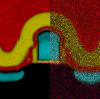
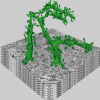
Example of an application using 3View: a volume of 16'000 cubic microns has been obtained with 3View and a neuron present in the volume is reconstructed in order to study the synapses received from inhibitory neurons.


Block face imaging in the SEM
3View uses a specially designed ultra-microtome operating in situ within a variable pressure, Field Emission SEM, and allows automated acquisition of 3D ultrastructure by sequentially imaging the freshly cut, resin embedded block face.

Perfect image stack alignment
Due to the technique of serially imaging the block face rather than individual sections, and because of the stability of 3View's stage, there is excellent registration between all images within an image stack. This allows simple exporting of the image files for 3-D rendering by 3rd party software, without the need for tedious post-processing.

High resolution results
3View's unique design allows a relatively short SEM working distance to stay exactly constant throughout a cutting sequence. Furthermore, a finely focused electron probe and small interaction volume enables a spatial resolution over 1 order of magnitude superior to that of confocal microscopy, and approaching the nanometer scale. As there is no depth probing, this 3D resolution is maintained throughout the sectioning depth.

Depending on the specimen and its preparation, 30nm thickness slice removal can be obtained. Similar fine depth resolution in the image contrast mechanism can be achieved with optimised injection conditions and a very high sensitivity BSE detector.


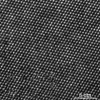
 3View data of retina with extra-cellular horseradish peroxidase (HRP). Horstmann, Euler, Hausselt, Briggman, Denk; MPI for Medical Research Heidelberg are kindly acknowledged for their collaboration and specimen preparation.


  • Stability for large image stacks acquisition over extended time (days)

  • No wasted time

  • Imaging over a significant volume

  • Unattended operation

  • Easy to use

  • One software platform  


  • Specimen preparation, image contrast and resolution
    Specimen preparation and the image contrast mechanism are based on heavy metal staining, fixing and resin-embedding, a technique well established in the field of TEM of thin sections.
    Specimen blocks are ideally pre-trimmed and faced before being transferred to the in situ 3View system.

    Back-Scattered Electron (BSE) imaging is used to show ultra-structural biological detail according to the local density of the stain heavy metal atoms. A stronger BSE signal is associated with denser regions of high atomic weight. As TEM microscopy is well established in this field, 3View provides images of similar contrast, (which is simply the reverse polarity of a standard SEM BSE signal).

    A Field Emission SEM is required for best results as this enables high spatial resolution imaging with the required long term stability. Variable pressure mode is required to avoid resin sample charging. A small spot size helps maximize spatial resolution, but since the BSE signal is being measured, the ultimate spatial resolution will depend on the specimen preparation, and column conditions required for adequate contrast and signal to noise. For maximum 3D spatial resolution, and to avoid charging, very low injection conditions are required and an optimised BSE detector is essential for this application.

    System Description

    High-stability in-situ ultra-microtome, stage and imaging system, to allow Serial Block Face Scanning Electron Microscopy within a Variable Pressure Field Emission SEM*.

     
    1. the knife is aligned with the block face and ready to cut

     
    2. the knife is moving and shaving the surface of the block removing 50nm resin


    3. the knife has shaved the surface and is retracting to its original position


    4. the surface of the block is scanned and the backscattered electrons generate the image

    Includes:

    • High precision in-situ ultra-microtome, capable of cutting slices of < 50nm
    • Diamond knife
    • High stability x-y- stage (movements sufficient to cover 1mm x 1mm specimen block)
    • SEM stage door and low noise electrical feedthroughs
    • System electronics for software control of microtome and stage movement, and DigiScan IITM for additional microtome control and image acquisition
    • Optical microscope, bench top alignment stand, stage door mounting stand, lighting and live movie camera to aid setup and coarse specimen approach
    • Optional : Special BSE detector, optimised for low kV imaging

    3View software features

    Setup monitoring
    Video streaming from optical microscope

    DigitalMicrographTM Control and Acquisition

    • Control of knife and specimen advance / retract parameters
    • SEM column communication for magnification, focus, astigmatism, beam blanking
    • DigiScan IITM digital beam control for imaging with wide choice of pixel density, aspect ratio, pixel dwell time, persistence for search and preview, multi frame integrate for record mode and simultaneous imaging inputs
    • Control of stage position, including point and go feature with automatic backlash removal
    • Column communication for control / knowledge of external scan control, magnification, focus, astigmatism, beam blanking
    • Automatic 3D acquisition of single or multiple slices at different locations and/or magnifications
    • Image monitoring to initiate debris cleaning or other thresholding actions.
    • Reviewing of live 3D stacks during acquisitions
    • Configurable auto-survey routines

    Post Processing and Exporting Tools

    • 3D volume rebinning tools including creation of 3D thumbnails
    • Slice viewer and slice movie player, applicable to 3D file in RAM
    • Browser tool, applicable to files larger than RAM capability
    • Filtering and export tools for use with 3rd party 3D software routines

    Serial Block-Face Scanning Electron Microscopy to Reconstruct Three-Dimensional Tissue Nanostructure