
Evaluating the robustness of spherical indexing under progressive EBSD pattern occlusion
Instruments used
EDAX® OIM Analysis™ and OIM Matrix™ software
Background
Reliable indexing of electron backscatter diffraction (EBSD) patterns becomes increasingly challenging when diffraction information is partially obscured by detector artifacts, shadowing, contamination, or limited pattern collection conditions. Traditional indexing approaches typically rely on the presence of multiple, clearly visible Kikuchi bands and may exhibit reduced performance as available pattern information decreases.
On the other hand, dictionary indexing can improve analysis of challenging patterns, but it carries a significant computational cost. Orientation determination requires comparison against a large library of simulated patterns, resulting in substantial processing time and memory requirements. These demands can make dictionary indexing impractical for routine analysis of large EBSD datasets, where rapid processing, high throughput, and accurate results are required.
EDAX spherical indexing takes a different approach. It utilizes a master pattern projected onto a sphere and determines the best crystallographic orientation by correlating experimental patterns with simulated diffraction information. This approach has demonstrated improved robustness for difficult EBSD datasets and lower-quality patterns. To assess its tolerance to incomplete diffraction information, the following study evaluates spherical indexing performance using EBSD patterns with progressively increasing levels of masking.
Materials and methods
A reference EBSD dataset of nickel with previously verified indexing results was used to evaluate spherical indexing performance. Individual EBSD patterns from this dataset served were re-indexed using spherical indexing, and the resulting orientations were compared with the verified reference results to quantitatively assess indexing accuracy.
Artificial circular masks were applied to the center of each EBSD pattern to systematically reduce the amount of available diffraction information. Starting from the unmodified pattern, the mask diameter progressively increased, obscuring increasingly larger portions of the central diffraction information while preserving the outer regions of the pattern intact. At each masking level, spherical indexing was performed using identical indexing parameters, enabling a direct comparison of indexing performance as the amount of visible diffraction information decreased.
Results
The results demonstrate that spherical indexing remains remarkably tolerant even as the amount of available diffraction information is substantially reduced. As shown in Figure 1, orientation solutions remain highly consistent with the reference dataset even as increasingly large portions of the pattern are obscured. Even at 92.2% original pattern coverage, spherical indexing was able to assign 68.15% of the data to the correct orientation.

A particularly notable observation is that spherical indexing performance remains exceptionally high up to approximately 80% pattern coverage. Despite only a relatively small fraction of the original pattern remaining visible, most pixels continue to yield the same crystallographic orientation as obtained from the complete diffraction pattern. This behavior highlights the ability of spherical indexing to extract orientation information from limited diffraction data.

Further analysis indicates that virtually no indexing degradation is observed until substantial portions of the diffraction information are removed. As shown in Figure 3, orientation retention rates of 99% or greater are maintained up to approximately 37.5% of the pattern area masked, demonstrating that spherical indexing can tolerate moderate pattern obstruction with minimal impact on indexing accuracy.

To illustrate how spherical indexing results are presented within EDAX OIM Analysis 9.1, Figure 4 compares the software output for an unmodified EBSD pattern and a pattern with 86.5% central masking. Despite the substantial reduction in visible diffraction information, spherical indexing identifies the same crystallographic orientation during routine analysis. Additionally, the 5 s flicker visualization can be used to rapidly compare the patterns and indexing results, providing a convenient qualitative assessment of the similarity between the diffraction information and the resulting orientation solutions.
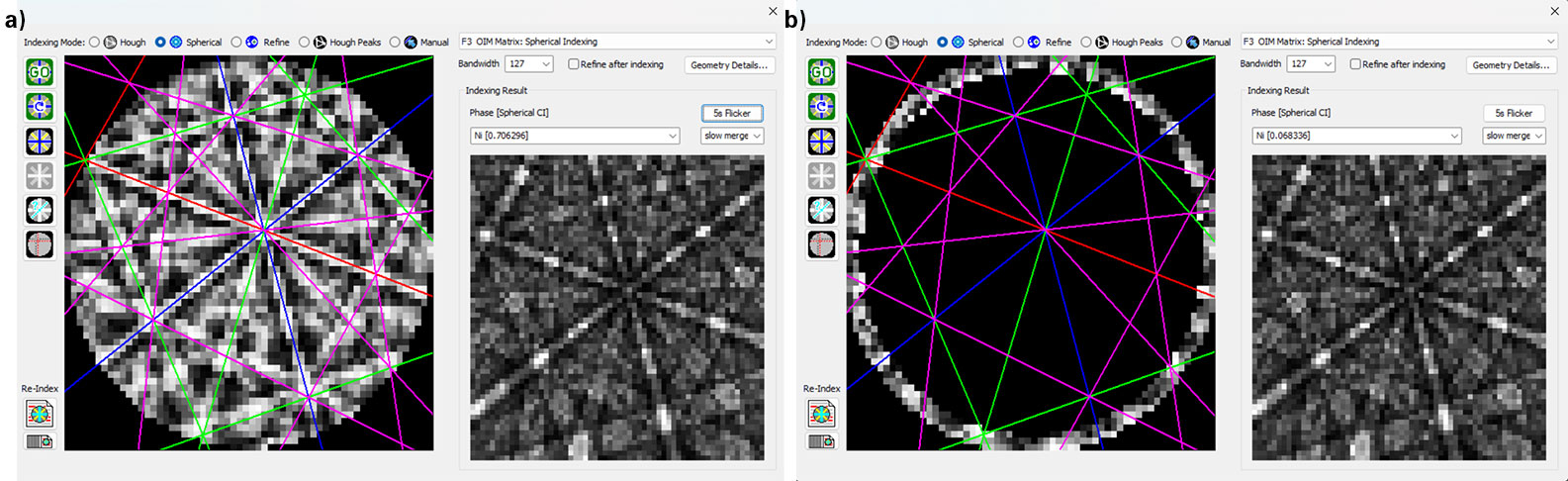
Figure 4. A side-by-side comparison of spherical indexing results in OIM Analysis 9.1. a) The original EBSD pattern and resulting orientation solution. b) A pattern with 86.5% central masking and corresponding orientation solution. Despite extensive pattern occlusion, the same crystallographic orientation is successfully identified.
Summary
This study demonstrates the exceptional robustness of EDAX spherical indexing to missing diffraction information. By systematically obscuring increasing portions of EBSD patterns, the results show that reliable orientation determination can be maintained even when most of the pattern is unavailable.
Orientation retention remained above 99% with up to approximately 37.5% of the pattern area masked, while high agreement with the reference dataset persisted at substantially greater masking levels. Even with 86.5% of the pattern area obscured, spherical indexing successfully retained the reference orientation for 68.15% of pixels.
These results demonstrate that spherical indexing can effectively utilize diffraction information from limited visible regions of an EBSD pattern. This robustness can benefit both challenging applications and routine EBSD characterization, where shorter acquisition times, reduced signal levels, detector shadowing, contamination, or sample preparation effects may limit the amount or quality of available diffraction information.