
Revealing lithium alloy phases in indium solid state battery anodes
Gatan instrument used
Cipher® is the first and only system that reveals the distribution of lithium in scanning electron microscopes quantitatively.
Background
Indium is a highly promising material for solid-state battery anodes offering the potential of ultra-fast charging and high cycle stability. The indium-lithium intermetallic phases produced during operation suppress the formation of lithium dendrites that can short-circuit a battery and cause safety issues. Moreover, the indium-lithium alloys supply fast diffusion channels enabling full battery charging in under five minutes.
However, widespread commercial application has thus far been prohibited due to the high variability of performance, which is tied directly to the evolution of the lithium-indium phase(s) microstructure and the high cost. A lack of suitable analytical techniques to evaluate the microstructure of lithium-indium phases and their evolution over the operation cycle presents a significant hurdle in reliably delivering optimized performance.
Materials and methods
A solid-state battery sample constructed from LiNi0.5Mn0.3Co0.2O2 (NMC 532) cathode, indium anode, and solid electrolyte was analyzed after having undergone 50 cycles of charge and discharge. The sample was dismantled in a glove box at a low state of charge (30%) before a sample (10 x 10 mm) was prepared using a ZEISS Crossbeam 540 with fs-laser, subsequently a cross-section was prepared using the PECS™ II broad argon beam milling system. Evaluation of the anode-separator interface was performed using the Cipher system (Figure 1) installed on a ZEISS Sigma VP scanning electron microscope (SEM); the sample was kept under vacuum or in an inert gas atmosphere. Analysis revealed a pure indium anode with a significant concentration of lithium-rich secondary phases within 10 µm of a rough anode-separator interface. Phase analysis identified the secondary phases as predominantly InLi2, though some InLi3 and In3Li13 intermetallic phases were present within 2 µm of the anode-separator interface.
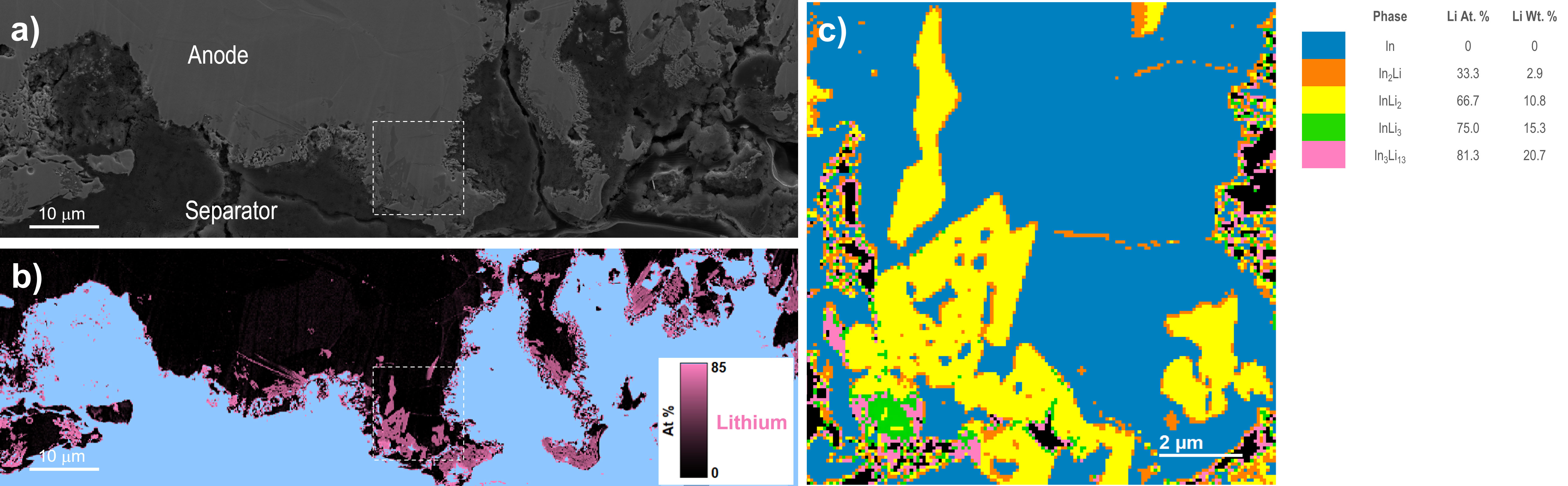
Figure 1. The secondary electron image a) reveals the rough anode-separator interface of a partially charged (30%) solid state battery. Elemental mapping using Cipher shows the anode to be predominantly indium (map not shown) with significant presence of lithium-rich secondary phases (b) within ~10 µm of the anode-separator interface. The phase map c) identifies the secondary phases as predominantly InLi2 though some InLi3 and In3Li13 intermetallic phases are present adjacent to the anode-separator interface. The lithium and phase maps were produced using Cipher and, for ease of data processing, the lithium analysis was limited to the anode region only; areas not analyzed here are indicated in image b) by blue fill. The phase map c) was created from the sub-area indicated in images a) and b). For the Cipher analysis, energy dispersive x-ray spectroscopy (EDS) analysis was performed at 15 kV/2 nA and quantitative backscattered electron imaging at 10 kV/0.2 nA; a pure indium standard was used as an internal reference. EDS spectra were extracted using eZAF standardless analysis and a computed Bremsstrahlung background.
Summary
The microstructure of secondary lithium-indium phases within the indium anode of a solid-state battery at a low state of charge was revealed in the SEM for the first time using Cipher. Demonstration of the ability to observe and characterize the lithium-rich microstructure of indium anode solid-state batteries reliably promises to accelerate the development of ultra-fast full battery charging.
Acknowledgement
This experiment brief was produced in collaboration with ZEISS, who also provided the sample.