
Understanding precipitate behavior in aluminum alloys: EBSD insights for aerospace and defense performance
Introduction
Aluminum 6xxx series alloys have become a cornerstone material across transportation, architectural structures, aerospace components, and defense related systems due to their balance of strength, corrosion resistance, and exceptional extrudability. Their performance is governed not only by their Al Mg Si base chemistry, but by the formation, distribution, and evolution of strengthening precipitates—primarily Mg2Si, along with secondary Si or Al Mn Si phases—which determine both mechanical behavior and long term reliability in service. Understanding which precipitates are present, how large they are, and how they interact with the surrounding aluminum matrix is essential for predicting alloy performance, especially in applications where weight, durability, and resistance to deformation are critical. As these alloys are deployed in increasingly demanding environments, precise microstructural characterization, down to the individual precipitate, has become fundamental to ensuring that components fabricated from these alloys achieve their designed performance.
Methods
Accurately identifying precipitate phases in aluminum alloys presents a unique challenge for electron backscatter diffraction (EBSD), particularly when differentiating between phases with similar band geometries or contrast, such as aluminum and silicon. Traditional workflows often rely on simultaneous energy dispersive spectroscopy (EDS) acquisition to assist with phase discrimination, but this becomes increasingly problematic at small precipitate sizes where the interaction volume of the electron beam far exceeds the physical dimensions of the features of interest.
At these scales, EDS signals blur together, and the spatial resolution mismatch between EBSD and EDS can mask subtle phase distinctions. Spherical indexing offers a powerful solution by comparing experimentally collected EBSD patterns directly with simulated master patterns for each candidate phase. Instead of depending on auxiliary chemical information, the method leverages pattern correlation to reliably distinguish even closely related phases, enabling precise phase identification and improved confidence when characterizing fine precipitates and their influence on the aluminum matrix.
Materials and results
With these challenges in mind, spherical indexing provides a pathway to far more reliable phase identification in complex aluminum microstructures. By directly correlating experimental EBSD patterns with simulated master patterns, the method yields indexing solutions that are more robust—even for nanoscale precipitates where traditional EDS assisted approaches begin to fail. This capability becomes apparent when examining the spherical indexing confidence index maps shown in Figures 1a and 1b. These images reveal a distribution of individual phases and precipitate clusters embedded within the aluminum matrix, with high confidence regions clearly delineating distinct phases that would otherwise be difficult to separate using conventional EBSD techniques. The maps not only confirm the presence of multiple precipitate types but also set the stage for examining how these phases interact with and locally deform the surrounding aluminum lattice, providing a foundation for deeper microstructural interpretation in the sections that follow.
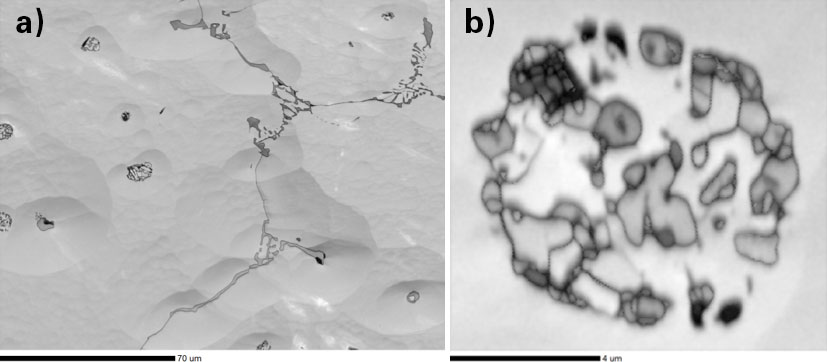
Figure 1. Spherical indexing confidence index maps of a) precipitates and b) precipitate clusters within a 6xxx aluminum alloy.
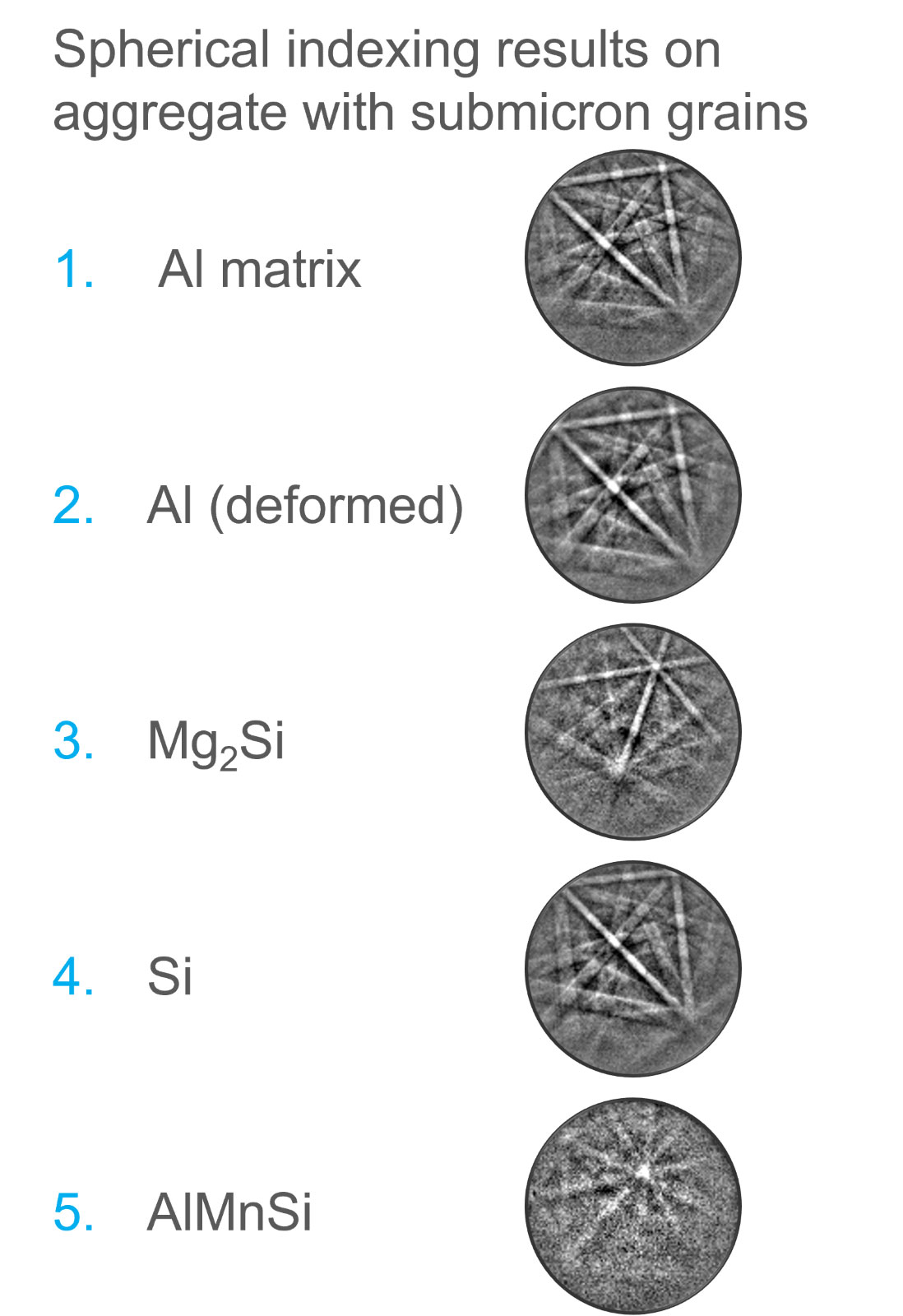
Figure 2. Representative EBSD patterns selected from phases within this observed precipitate cluster acquired with the Velocity detector, showing patterns from: 1) aluminum matrix, 2) locally deformed aluminum within the cluster, 3) Mg2Si, 4) Si, and 5) AlMnSi phases.
To more fully characterize the crystallographic diversity within the precipitate cluster, all EBSD patterns acquired during mapping with the EDAX® Velocity™ detector were saved, allowing individual patterns from each phase to be examined in detail after collection. From this comprehensive dataset, representative patterns were selected for the key constituents of the microstructure: the primary aluminum matrix, the locally deformed aluminum within the cluster, the Mg2Si phase, the Si phase, and the AlMnSi phase, as shown in Figure 2.
Figure 3 presents the resulting color coded phase map, which illustrates the spatial distribution of these phases within the cluster. Capturing high quality EBSD patterns from all phases was enabled by broad ion beam polishing using the PECS™ II instrument. This preparation method avoids the differential surface damage and relief often introduced by conventional metallographic polishing, ensuring consistent pattern quality across chemically and mechanically diverse phases. Together, the saved patterns and the resulting phase map underscore the effectiveness of advanced EBSD acquisition and preparation methods for resolving the full phase complexity of aluminum 6xxx alloy microstructures.

Figure 3. Color coded phase map revealing the spatial distribution of aluminum, Mg2Si, Si, and AlMnSi within the precipitate cluster. Surface preparation by the PECS II broad ion beam polishing enabled consistent pattern quality across all phases.
The grain reference orientation deviation (GROD) coloring of the aluminum phase in Figure 4 further highlights the deformation contrast between the aluminum matrix and the aluminum within the precipitate cluster. In the surrounding matrix, the GROD values remain low, reflected in the uniform blue coloring that indicates minimal lattice rotation and a largely undeformed state. In contrast, the interior of the precipitate cluster shows a broad distribution of warmer colors (greens/yellows), signaling higher local orientation spread.

Figure 4. GROD coloring of the aluminum phase highlighting low orientation deviation (blue) in the matrix and elevated, distributed deviation (green–yellow) within the precipitate cluster, indicating localized strain accommodation around hard, non-deforming phases.
This elevated GROD response suggests that the aluminum within the cluster has accommodated strain differently than the bulk matrix, likely due to the presence of multiple, mechanically distinct precipitates that interact with the surrounding lattice. Several factors may contribute to this behavior: heterogeneous thermal contraction between precipitates and matrix during cooling, local misfit strains introduced during precipitate formation, or dislocation accumulation caused by the hard, non deforming phases acting as barriers to slip. The distributed nature of the elevated orientation spread within the cluster implies that deformation is not confined to isolated precipitate interfaces, but instead reflects a broader, cooperative strain field shaped by the combined presence of the Mg2Si, Si, and AlMnSi phases. This microstructural complexity highlights the value of EBSD in resolving how precipitation influences local mechanical response in 6xxx series aluminum alloys.
Conclusion
Together, these results demonstrate how modern EBSD workflows: EBSD pattern acquisition using the EDAX Velocity detector, spherical indexing, and deformation free preparation via the PECS II enable reliable identification of precipitate phases and detailed mapping of their influence on the surrounding aluminum matrix. By linking phase identity, distribution, and local deformation behavior at the microscale, this approach provides actionable insight into how processing and service conditions shape alloy performance. Such understanding is increasingly important as 6xxx series aluminum alloys continue to support lightweight structural designs in advanced transportation, aerospace platforms, defense applications, and other demanding environments where predictable mechanical behavior and long term reliability are essential. High confidence microstructural characterization ensures these materials can meet the rigorous performance expectations associated with these applications.
Acknowledgement
Aluminum alloy samples provided by Dr. Johannes A. Österreicher, AIT Austrian Institute of Technology.