Revalorization of agro-industrial waste as a catalyst source for production of biofuels
Renewable Energy
2021
Development of inexpensive solar cells and photovoltaic materials with efficient solar-to-electric energy conversion is one of the most important challenges we face to offset electricity obtained from burning fossil fuels. Established technologies are available in modules with 15 – 20% efficiencies, however they are still too expensive to manufacture. To overcome this obstacle, researchers are looking to optimize existing crystalline silicon or thin film (e.g., copper indium gallium selenide (CIGS), cadmium telluride and amorphous silicon) solar cell architectures as well as explore new designs based on inorganic quantum dots and organic thin films. To advance solar-to-electric energy conversion, it is necessary to understand and control the dynamics of hot electron and hole relaxation, cooling, charge transport, and interfacial charge transfer of the photogenerated carriers. Useful information to characterize these state of the art photovoltaics includes:
To adequately characterize and understand materials that affect your product’s energy output, you must first ensure each specimen is of the highest quality to resolve the material interface and properly controlled so you manipulate it, when necessary, under environmental stimuli. Once prepared, several techniques are available to better understand the relationship between microstructure, defects and the optical properties of materials.
|
Provides unique nanoscale optical insights into materials by revealing crystal defects, electronic structure, and trace-element chemistry—information often inaccessible through other techniques. Discover more at WhatIsCL.info. |
Electron backscatter diffraction (EBSD) Allows detailed microstructural analysis by mapping crystal orientations, phases, and grain boundaries, helping researchers understand material properties, deformation, and failure mechanisms at the microscale. |
|
Electron energy loss spectroscopy (EELS) Delivers atomic-scale insights into elemental composition and chemical bonding—enabling a deeper understanding of material properties to advance fundamental research and discovery. Includes energy-filtered TEM (EFTEM). Elevate your EELS at EELS.info. |
Energy dispersive x-ray spectroscopy (EDS/EDX) Facilitates rapid, reliable elemental analysis by detecting characteristic x-rays emitted from a sample, allowing researchers to identify and quantify major, minor, and trace elements across a wide range of materials. |
|
Integrates EELS, EDS, 4D STEM, and more to deliver rich, correlated insights—advancing the understanding of complex, dynamic nanoscale phenomena. |
Delivers high-resolution visualization of biological and inorganic specimens, enabling researchers to study ultrastructure, material growth, and failure mechanisms with exceptional clarity. |
|
Captures real-time nanoscale dynamics under controlled stimuli to uncover fundamental mechanisms and accelerate scientific discovery. |
Integrated SEM Combines EDS, EBSD, CL, BSE, and WDS into unified platforms—delivering comprehensive, high-resolution insights that streamline workflows and deepen understanding of complex materials. |
|
Micro x-ray fluorescence (micro-XRF) Delivers high-resolution, non-destructive elemental analysis—ideal for layered, sensitive, or irregular samples. |
Wavelength dispersive x-ray spectroscopy (WDS) Offers high spectral resolution and sensitivity, enabling precise identification and quantification of trace and light elements in complex samples—especially where overlapping x-ray lines challenge other techniques. |
Visit batteries and energy storage or geosciences for related applications.
Analyze chemical phases
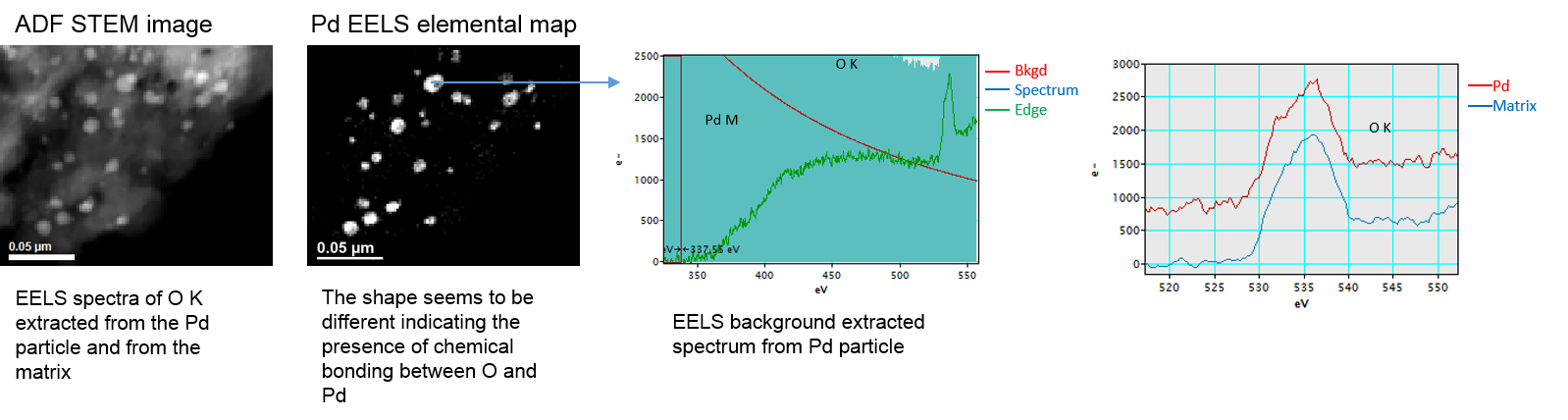
When you correlate particles within an image with EELS analyses, the results deliver insight into the chemical interaction of metals within catalytic systems for oil refineries.